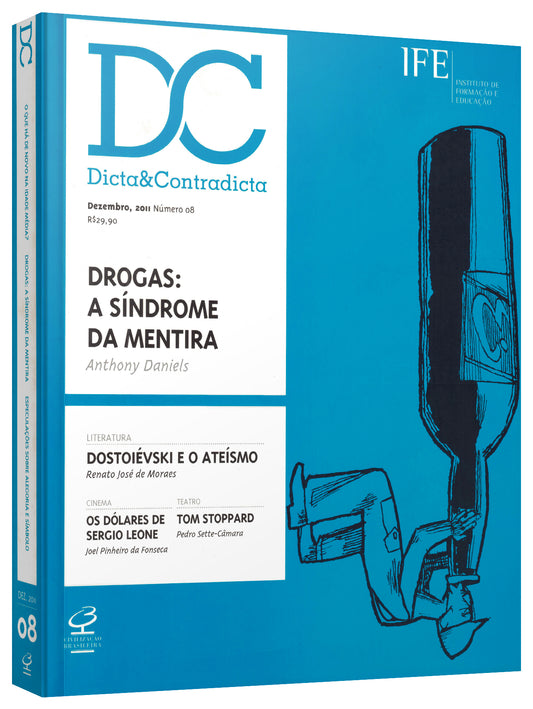
Dicta&Contradicta magazine reaches its fourth year with issue number 7, now in partnership with Grupo Editorial Record. This partnership cements Dicta, a magazine of essays and debates, in the Brazilian publishing market, where it has repeatedly topped the bestseller lists in its segment. This issue features 34 essays by more than 30 different authors, with a clear and in-depth approach to topics ranging from international politics to French cinema, from political philosophy to art criticism, including previously unpublished short stories and poems, book reviews, and classic texts. The magazine begins with an exclusive interview with Yves Bonnefoy, considered the greatest living French writer today, carefully crafted by English translator and critic Chris Miller. Bonnefoy also appears in other sections of the magazine, such as the essay "Yves Bonnefoy – To begin, a triptych," an introduction to his work, also written by contributor Chris Miller, and the "Translated Poem" section, with previously unpublished Portuguese versions of his most recent poems by Mario Laranjeira. Dicta&Contradicta also addresses controversial topics such as the Cesare Battisti case, with a fierce analysis by English writer Anthony Daniels on his literary production and years of exile in France, rarely discussed topics in the Italian's life. Another highlight of the magazine is the "From the Other Side" section, featuring four short and irreverent essays by set designer, screenwriter, and polygraph artist David Mamet, Pulitzer Prize winner and two-time Oscar nominee (best screenplay for "Wag the Dog" and "The Verdict"). In his writing, he primarily addresses theater actors, and in his final essay, he offers tips for those new to the craft of drama, whose main and ultimate lesson is: "Always take your wallet to the stage." Dicta & Contradicta also features an unpublished essay by Rémi Brague that historically analyzes the atheism-superstition binomial, followed by a contribution from English historian Micheal Burleigh, outlining a panorama of the various atheist ideologies that used religion to justify their actions during World War II. The magazine was launched in June 2008. Since its debut, it has been introducing the Brazilian public to young writers and intellectuals renowned in Brazil and around the world. A critical and sales success, the magazine has repeatedly been on the bestseller lists in its segment. The magazine has been renewing itself, just as it has grown. "Renewal means, above all, returning to our roots, to the ideals that drive us. It's time to invite readers to reflect with us on what we intend to do and how to conceive our mission," says Guilherme Malzoni Rabello, president of IFE (Institute of Training and Education, which created the magazine) and editor of the publication. During its four years of existence, Dicta has operated under the fundamental idea that culture is important for contemporary society, and in this issue, it particularly combats the widespread notion that culture, especially high culture, is something extra, a "icing on the social cake" that's left over. This goes against the view that, in a country like ours, concern should be limited to immediate needs—education, health, food. Quite the opposite, the editorial initially advocates. "For better or worse, thought is the father of action, and thought, understood socially—culture—is supported at its summit by those rare individuals who are especially gifted at capturing reality and reflecting on it, and expressing it conceptually or artistically. In 'intellectuals,' in short, especially those who cultivate 'high culture,' initially read by few, but later explained, adapted, translated, commented on, criticized, accepted, or rejected by the masses," the text states. Even recognizing the global deficits in the areas of human rights, international politics, social issues, and the environment, Dicta believes that culture contributes nothing, or has historically contributed nothing, to the solution of these problems. Culture guarantees a basic level of development. "And Brazil seems to have reached and even surpassed this point."