Studies on the Urban Network, by geographer Roberto Lobato Corrêa, brings together eight texts produced since the second half of the 1980s. It represents the culmination of a long process of empirical studies and reflections on the topic of the urban network, a process that began 40 years ago with the study on the evolution of the urban network of Alagoas, published in the Annals of the Association of Brazilian Geographers. Understood as the functionally articulated set of urban centers, the urban network constitutes simultaneously a reflection, a milieu, and a social condition, thus deserving the attention of those interested in society and its dynamics. The topic at hand is part of the tradition of the social sciences and has a strong presence in geography. The topic of the urban network was strongly influenced by Walter Christaller's classic work, published in 1933, a work still considered a necessary reference, despite criticism. Studies on the Urban Network pays homage to Christaller, those who preceded him, and those who followed, including Brazilian geographers. The names of many of them are printed on the cover, honored for their contributions to the study of the urban network, including the development of this book. Without them, this book would not have continued its quest to gain understanding of a complex and changing spatial organization engendered by human action. The topic at hand has a history marked by periods of profusion of studies and periods of neglect in Brazil. Transformed into an instrument of regional planning, the production of studies on the urban network is subject to the interests of planning, not considered a topic of fundamental importance for critically considering Brazil. Studies on the Urban Network seeks, in this sense, to frame the topic of the urban network within the realm of academic debate. For the urban network is simultaneously a reflection, a means, and a social condition, an integral part of society and its movement. The urban network and society are inseparable. A proposal on how to study the urban network begins the book. Next, two studies address the relationship between the urban network and the dynamics of the Brazilian banking network, on the one hand, and the actions of a large, multifunctional, multi-locational corporation, on the other. The third part contains five studies on the Amazon, the dynamics involving small cities, spatial formation and the Brazilian urban network, the recent dynamics of the urban network, and a description of aspects related to the articulation of the main centers of the Brazilian urban network.
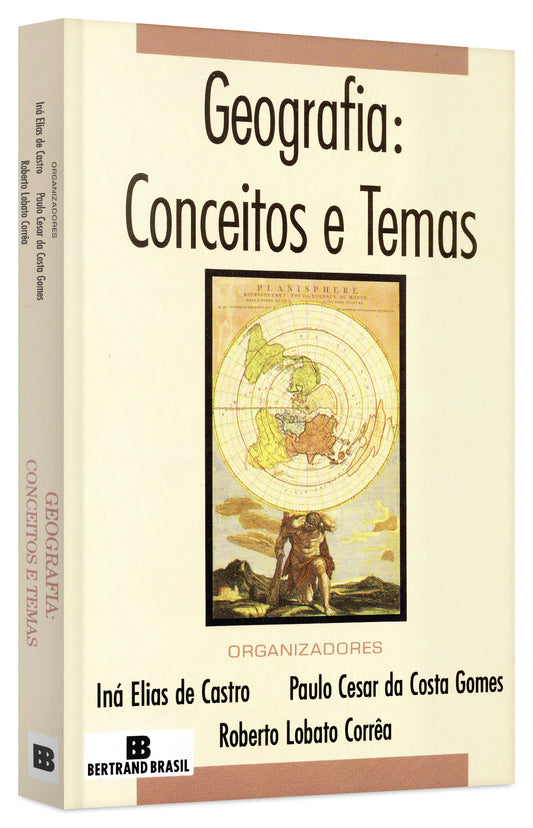
Geografia: Conceitos e temas é o resultado de um esforço conjunto de reflexão e atualização dos debates da Geografia contemporânea, não só no que diz respeito à reconstrução de seus conceitos fundadores como também nas possibilidades de sua aplicação aos problemas com as quais as sociedades modernas se defrontam.
Desta forma, o público ao qual ele se destina compõe-se de profissionais ligados ao ensino superior, aos estudantes de graduação, aos graduados que procuram uma atualização, aos profissionais de outras áreas que se aproximam dessas reflexões, e a todos aqueles que se interessam por problemas que afetam a dinâmica espacial.