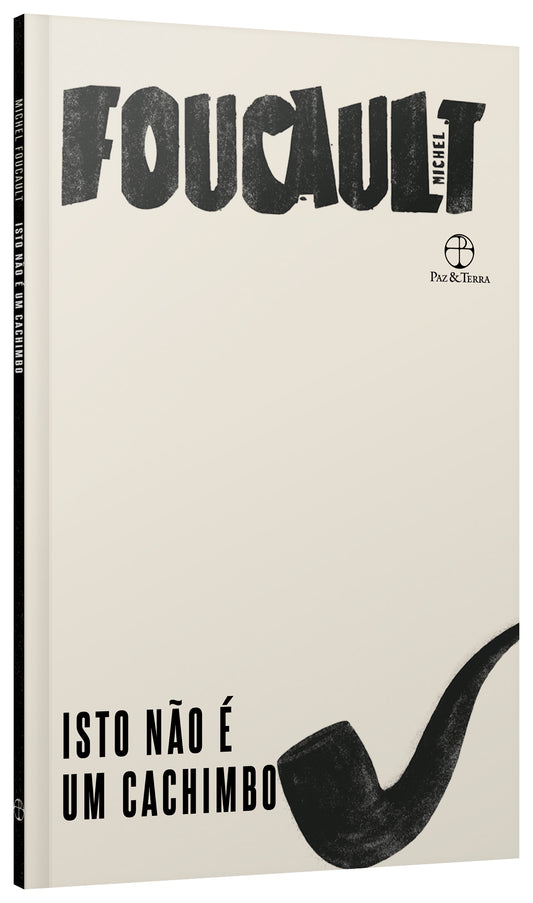
Painting always fascinated Foucault. But he wrote little about it. There are three presentations of painters from the 1970s, the most notable of which is the text on Fromanger, which analyzes his use of photography in image creation. Besides these presentations, there are only three texts: the article on Velázquez's Les Nières (1965), inserted with modifications into *The Order of Things* the following year, which analyzes the Spanish painter's painting as a representation of classical representation; the draft of a book on Manet, which, for some unknown reason, he destroyed, and of which remains a recording of a lecture given in Tunisia in 1971, now published; and "This Is Not a Pipe," the most important of these due to the complexity and relevance of its subject matter, which fits perfectly with the issues that occupied him at the time. Thus, to understand this difficult text, it's helpful to consider that it was first published in 1968—as a tribute to René Magritte, who had died the previous year—two years after the philosopher wrote The Order of Things, and that it originates from one of the letters the painter addressed to him after reading that book, or from the chapter on Les Mères, in which he reflects on the notions of resemblance and similitude. One can, therefore, take this writing by Foucault as a reflection on Magritte's idea that "things do not have resemblances, they have similitudes. Only thought is given to be similar." What, then, does Foucault do, inspired by this idea? He analyzes the two drawings "This is not a pipe," several other paintings by Magritte, and the relationship of his pictorial procedure to those of Klee and Kandinsky, to show how, in the 20th century, a type of painting he felt close to in his theoretical research on the human sciences and literature broke with the principles of Western painting in force since the 15th century. More specifically, by emphasizing the relationship between drawing and statement, figure and sign, Foucault's main objective, at this time when he was reflecting on his own methodological procedure in preparation for his 1969 Archaeology of Knowledge, was to explain how Magritte broke with the postulate of representation, inaugurating a form of painting that questions the common space, the "common place" between image and language. Roberto Machado
Michel Foucault (Poitiers/França, 1926–Paris/França,1984), segundo Roger Pol-Droit, é “um filósofo que escruta o plano das penitenciárias, em vez de meditar sobre o esquecimento do Ser. Que prefere os relatórios de polícia às provas da existência de Deus. Pensador astuto, não cessa de mudar, de desfazer sua identidade, de multiplicar as silhuetas em uma emboscada.” Pela Paz e Terra, publica História da sexualidade (4 volumes), Metafísica do poder, Isto não é um cachimbo e Eu, Pierre Rivière que degolei minha mãe, minha irmã e meu irmão.