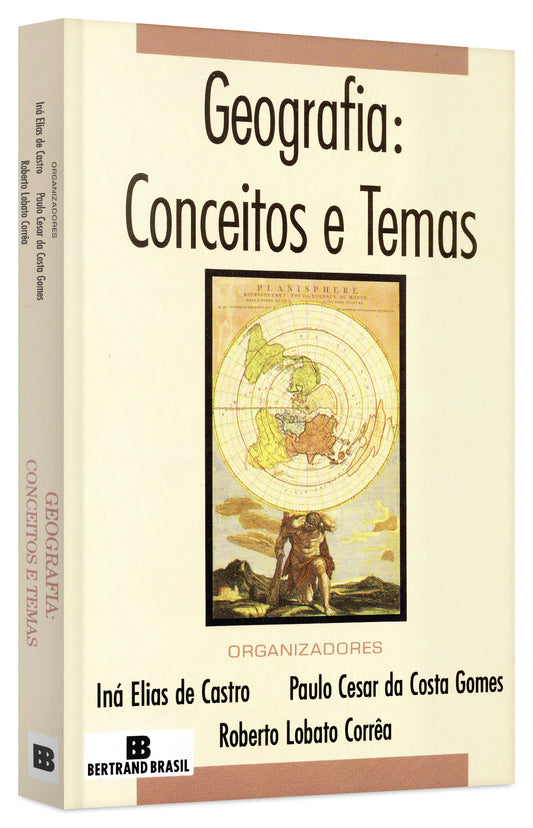
Rediscovering Brazil addresses relevant topics in Geography, Territorial Management, and Development. Its main goal is to understand contemporary Brazil facing the challenges of globalization and South American integration, even if some texts attempt to situate these issues within a theoretical context. And it is precisely in this aspect that the book assumes importance. The process of financial integration on a global scale, far from leading to the end of Geography, demonstrates its relevance for understanding the accelerated changes occurring in the territory and the rebirth of place as a seminal nucleus of culture and ideas. In the pores of homogenization, technological advances are highlighting differences, and the Internet is a mosaic of languages and disparate attitudes toward the modern world. Indeed, for the first time in human history, the true meaning of the world, as a community of ideas coexisting in the same habitat, becomes real on a planetary scale. However, this does not mean the end of conflict, but rather its emergence in new forms. Networks connect places, but do not occupy them. By breaking down the borders of nation states, they allow the emergence of a modern form of spatial "Bonapartism"—that is, the absence of hegemonic power over the entire territory, opening gaps where nuclei generate alternative networks and loci of survival for the excluded. Only in this way is it possible to understand how, in the heart of MERCOSUR, the largest economic bloc south of the Equator, territories such as the "Triple Frontier" or the "Pontal do Paranapanema" emerge, as places distinguished by alternative forms of power. To help understand these apparent enigmas inscribed within Brazilian territory, the organizers of this book have selected a set of texts that address the spatial theme in its various facets. The controversial aspects of South American integration are analyzed, highlighting its advances and pointing out the contradictions between goals assumed by governments and the real results for the population directly involved. A discussion on the urban and regional framework in contemporary Brazil evaluates the effects of recent processes, still little covered by statistics, on the organization of Brazilian space. The contribution of the theory of modern Geography to current thinking points here to the importance of the cultural dimension in the architecture of space, while the geometry of centers and margins in the recent design of the territory is discussed, with emphasis on the role of those who are on the margins of the transformations that occur at the center of decisions. Regarding borders, a reflection on the new meaning of their multiple dimensions discusses the role of technical and scientific knowledge in the new delimitation and scope of national sovereignty. Current problems of territorial management and the limits of governability at various scales of management, as well as the emergence of new, not always legal, networks of power exercise in space, are addressed from the perspective of disputes and territorial representation of political actors. Globalization and sustainable development are notions still fraught with controversy, their scope still poorly defined. The impacts of new ways of organizing production, in rural and urban areas, and of utilizing the original frontiers of wealth—land and labor—are also discussed. The book is completed with analyses of technical changes and their impacts on spatial structure, both for production and the daily lives of social agents. With this comprehensive panel, the organizers hope that readers will not only have broadened their understanding of the uncertainties of this end-of-the-century kaleidoscope, but also be convinced that today, more than ever, Geography lives.
Iná Elias de Castro é professora e pesquisadora do Departamento de Geografia da UFRJ, com Pós-Doutorado pela Universidade de Sourbonne em Paris, sendo também autora do livro O Mito da Necessidade e organizadora de Brasil: Questões Atuais da Reorganização do Território e Geografia, Conceitos e Temas.