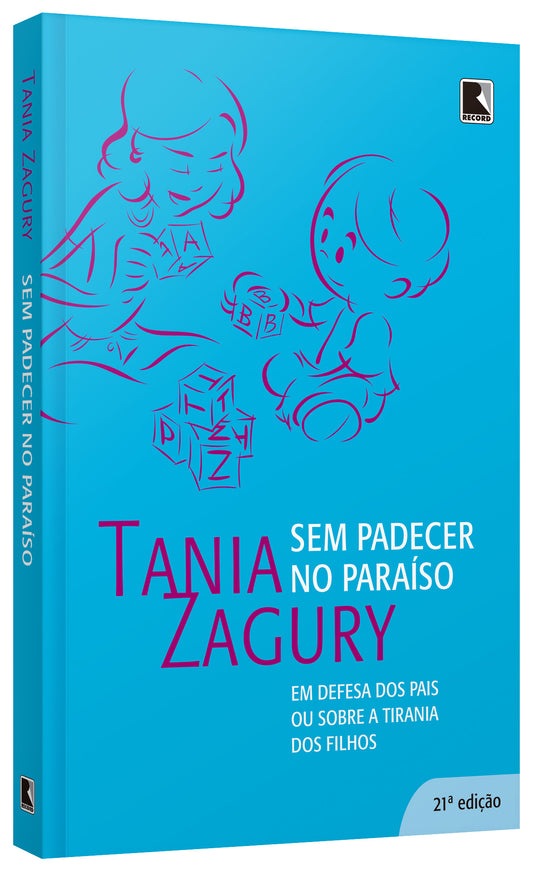
Normal 0 21 false false false MicrosoftInternetExplorer4 st1\:*{behavior:url(#ieooui) } /* Style Definitions */ table.MsoNormalTable {mso-style-name:"Normal Table"; mso-tstyle-rowband-size:0; mso-tstyle-colband-size:0; mso-style-noshow:yes; mso-style-parent:""; mso-padding-alt:0cm 5.4pt 0cm 5.4pt; mso-to-margin:0cm; mso-to-margin-bottom:.0001pt; mso-pagination:widow-orphan; font-size:10.0pt; font-family:"Times New Roman"; mso-ansi-language:#0400; mso-fareast-language:#0400; mso-bidi-language:#0400;} In the more than a thousand lectures that educator Tânia Zagury has given across the country, some questions about the parent-child relationship recur and are raised in practically every one. They constitute, therefore, doubts that permeate the daily life of the modern family. Based on the conviction that the uncertainties of many indicate general problems that cannot be ignored, but rather must be considered, analyzed, and overcome, "Educating Without Guilt: The Genesis of Ethics" was written. Its nineteen chapters reflect, therefore, recurring questions that parents grapple with daily in their effort to reconcile and meet, simultaneously and in the best possible way, two seemingly irreconcilable goals: on the one hand, educating their children for conscious citizenship and, on the other, considering the desires, characteristics, and idiosyncrasies of each of their children, within the modern perspective of respect for individual differences. The author, a philosopher and master in Education with over three decades of experience in teaching, shows that this incompatibility is false. Reflection and awareness are the mechanisms she uses to overcome this duality that wears down, produces uncomfortable feelings of guilt, and prevents parents from leading a more peaceful and happy life. Thus, among other topics, she discusses here, such as jealousy between siblings, the influence of television exposure, limits in adolescence, the role of grandparents, and parents' fear of not being able to raise children capable of facing a competitive and unfair society. According to Tânia Zagury, parents need to understand and embrace the premise that their most important goal is to teach ethical principles, such as honesty, solidarity, and mutual respect, even though society conspires to foster the idea that satisfying their children's desires is the fundamental task. Originally published in 1993, Educating Without Guilt became an instant classic, read by thousands of parents to this day. In it, their main anxieties are analyzed and dissected, not with the aim of providing profound or complete answers, but rather to lead to profound reflection, grounded in ethics and the construction of a democratic space within the family. It is essentially, and ultimately, an attempt to reposition parents as builders of morality and a system of values for their children, through a guiding principle that aims to free them from anguish and guilt. Guilt has haunted them since the 1980s, due to the gradual and excessive emphasis that today's consumerist and individualistic society has placed on psychological aspects to the detriment of social ones.