"
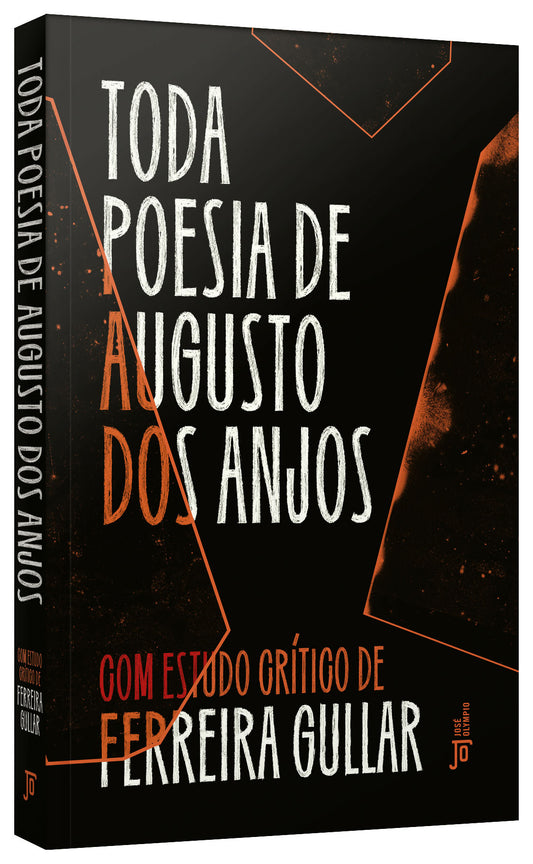
All poetry by Augusto dos Anjos, organized and prefaced by Ferreira Gullar, in a new graphic design.
The syncretic poetry of Augusto dos Anjos is collected in * All the Poetry of Augusto dos Anjos* , a work of great historical and artistic importance. Incorporating scientific language and colloquial traits, his sonnets anticipate modernism and address everyday issues from a raw and visceral perspective that, although shocking, proved extremely popular. In 1928, his book *I* , whose 58 poems are part of this collection, sold 1,000 copies in fifteen days! In these poems, the deterioration of matter and the eschatological take on a sublime aspect, and death—scientific, inevitable, and at the same time welcomed—presents itself as an extreme materiality.
Autobiographical elements and the political context are thus fundamental to this work of despondency, melancholy, and technique that troubled critics. Indeed, critics took a long time to become interested in Augusto's writings. Ferreira Gullar, author of the preface, corrects this delay and presents us with a precise analysis of the poet from Paraíba's work.
Influenced by authors such as Charles Baudelaire, Edgar Allan Poe and Cruz e Sousa, Augusto meticulously combines controversial themes and impressive sounds, as in the verses: “Spitting from one abyss into another abyss / Sending the smoke of a cigarette to Heaven / There is more philosophy in this spit / Than in all the morality of Christianity!”
Original and contemporary, all of Augusto dos Anjos' poetry is an invitation to reflect on human dilemmas and appreciate good poetry. Timeless.
“I read Eu as a teenager and it was like being punched in the face [...]. Astonishment was followed by intense curiosity [...]. I wanted to read more of this poet, different from the classics, the romantics, the Parnassians, the symbolists, from all the poets I knew [...]. Augusto dos Anjos continues to be the great singular case of Brazilian poetry.” Carlos Drummond de Andrade
“Reading and rereading the Self , we always discover new, strange, and admirable things. His surprising and extravagant rhymes open up previously unseen horizons; he resembles the English metaphysical poets , whom I had never heard of.” Otto Maria Carpeaux
"