The Eighteenth Brumaire of Louis Bonaparte

The Eighteenth Brumaire of Louis Bonaparte

Conteúdo do livro
CÓDIGO DA OBRA9786555481006
Sinopse

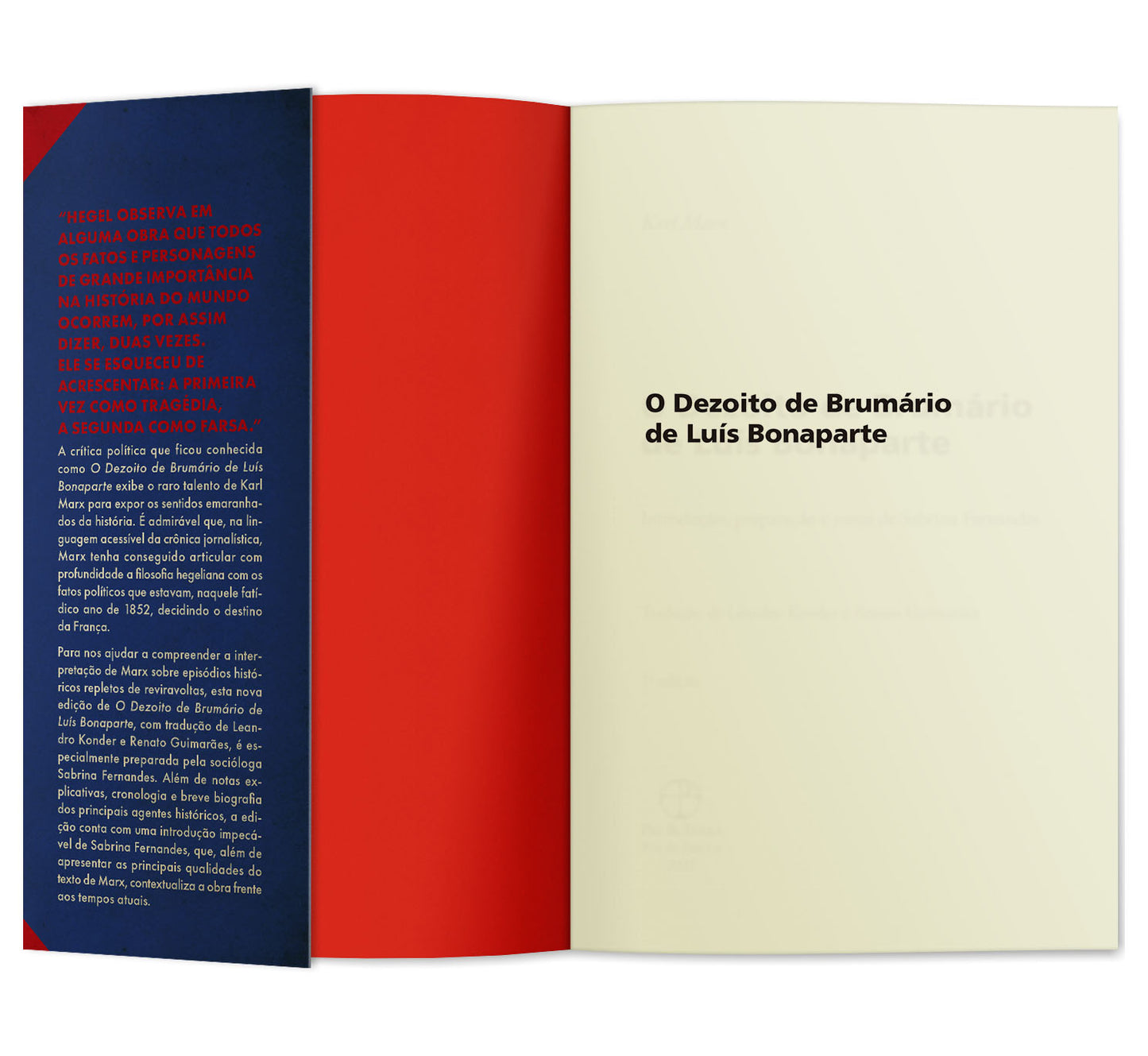
In this new edition of The Eighteenth Brumaire of Louis Bonaparte , Sabrina Fernandes re-presents and recontextualizes Karl Marx's classic political critique of Napoleon III's coup d'état against the backdrop of the reactionary tide of our times.

In The Eighteenth Brumaire of Louis Bonaparte , Karl Marx explains how France, which once again inspired the world to fight against monarchical absolutism through the February Revolution of 1848, turned out to be a caricature of its own contradictions.

After stemming a conservative backlash and deposing Louis Philippe I as king, the country elected Louis Bonaparte, nephew of its former emperor, Napoleon, as president of the newly declared Republic. Society allowed itself to be deceived by the new president's popular momentum, which, cloaked in overtures of expanded civil rights, led the coup d'état that crowned him Emperor Napoleon III, reestablishing the authoritarian position of Bonapartist power.

This is the historical context upon which Karl Marx focused in this work, a masterful critique that revealed the first empirical experiments of his materialism and became one of the most important texts in political science. This edition, translated by Leandro Konder and Renato Guimarães, features a preparation, introduction, and footnotes by sociologist Sabrina Fernandes, who presents the work's importance for our time and explains details of the German original in a way that is accessible to Brazilian readers. Thus, she continues the work of Marxist dissemination begun with The Communist Manifesto , taking her second step in the re-presentation of Karl Marx's editions published by Editora Paz & Terra.

We therefore have the opportunity to understand not only Marx's explanations for Napoleon III's coup d'état, but also how this type of strategy continues to be a recipe for charismatic leaders to subvert popular uprisings to their own advantage. Sabrina Fernandes teaches us how Marx's famous statement about tragedy and farce also clearly applies to recent political events in Brazil—from the June 2013 protests to the Jair Bolsonaro administration.

“Although Marx wrote The Eighteenth Brumaire of Louis Bonaparte in the heat of the moment, the work transcends the object of analysis and is the seed for the method that exposes the limits of bourgeois democracy and the attempt to prevent the advance of authoritarianism using only the tools and defense of that same bourgeois democracy.” – Sabrina Fernandes

“And everywhere there are still those who protest, who rebel, who fight. (...) It is for them that The Eighteenth Brumaire was written, it is for them that the text has not yet aged.” – Herbert Marcuse

“Written to narrate and interpret the events that culminated in a coup d'état, The Eighteenth Brumaire became fundamental to modern scientific thought.” – Octavio Ianni

ISBN978-655-548-100-6
Tradutor Leandro Konder, Renato Guimarães
Altura205 mm
Largura135 mm
Profundidade11 mm
Lançamento13/11/2023
Páginas240
View full details
Conteúdo do livro
CÓDIGO DA OBRA9786555481006
Sobre o autor

Karl Marx

Karl Marx (1818-1883) foi um filósofo, economista e comentarista político alemão. Sua crítica ao capitalismo, especialmente a contida em O capital, deu origem a visões político-econômicas que nortearam a criação de partidos comunistas em todo o mundo. Friedrich Engels (1820-1895) foi um industrial e filósofo alemão, e um dos principais críticos do capitalismo inglês. Trabalhou junto com Marx em diversos livros, sendo ele um dos primeiros defensores do marxismo. Sabrina Fernandes é doutora em sociologia, pós-doutoranda do Grupo Internacional de Pesquisa sobre Autoritarismo e Contraestratégias da Fundação Rosa Luxemburgo e da Universidade de Brasília, e produtora do canal Tese Onze, projeto de comunicação política e científica no YouTube.

Ver mais sobre o autor
Sobre o autor

Sabrina Fernandes

Karl Marx (1818-1883) foi um filósofo, economista e comentarista político alemão. Sua crítica ao capitalismo, especialmente a contida em O capital, deu origem a visões político-econômicas que nortearam a criação de partidos comunistas em todo o mundo. Friedrich Engels (1820-1895) foi um industrial e filósofo alemão, e um dos principais críticos do capitalismo inglês. Trabalhou junto com Marx em diversos livros, sendo ele um dos primeiros defensores do marxismo. Sabrina Fernandes é doutora em sociologia, pós-doutoranda do Grupo Internacional de Pesquisa sobre Autoritarismo e Contraestratégias da Fundação Rosa Luxemburgo e da Universidade de Brasília, e produtora do canal Tese Onze, projeto de comunicação política e científica no YouTube.

Ver mais sobre o autor