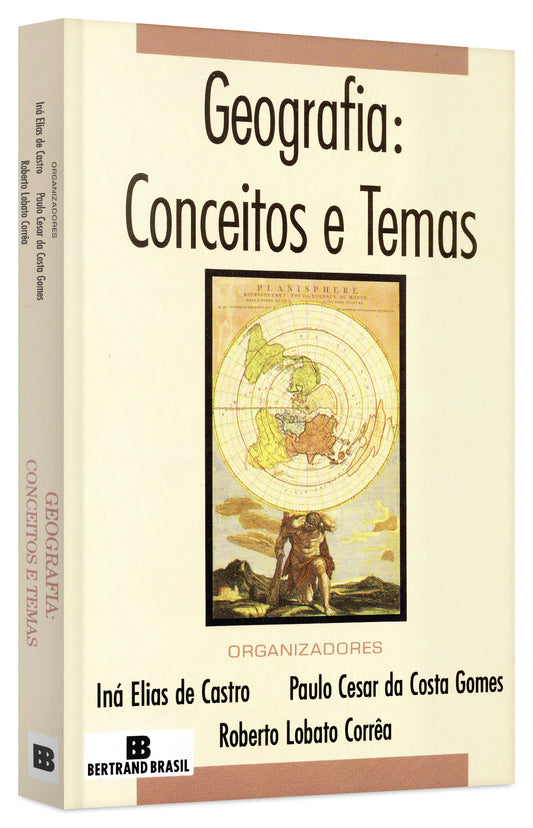
Author of well-known works - Geography and Modernity , The Urban Condition , The Place of the Gaze , among others -, Paulo Cesar da Costa Gomes proposes in his new book that geography is a way of thinking, a graphic way of structuring thought, and that the construction of geographical reasoning occurs through meaning, based on the play of positions between spatially located elements.
How is this reasoning structured? What is the common ground upon which geographic understanding operates? These are some of the fundamental questions addressed in Geographical Frameworks , a work recommended not only for undergraduate and graduate students, but also for all those curious to discuss and understand the properties and competencies of geographic knowledge.
"Geography is an original way of thinking. This is the hypothesis announced in the very first pages of Quadros Geográficos. As the reading progresses, the initial hypothesis unfolds into a fruitful statement: geography is a graphic way of structuring thought, founded on description, and whose elementary instrument is the frame. Taken broadly, the frame here designates any surface on which diverse elements are presented according to basic principles of location, extension, and morphology. The geographical reasoning that relies on this instrument is one that constructs meanings from the interplay of positions between spatially located elements, assembled in a composition that can be revealed graphically.
If the book's hypothesis is bold, its argumentative style is equally ambitious. The same frameworks that constitute the work's object serve as a resource to guide the reader through the demonstration of the central idea. Like frames, the chapters propose new perspectives that give rise to unprecedented associations between famous figures and their ideas—Ptolemy, Strabo, Kant, Humboldt, Vidal de La Blache, to name a few. Regrouped through new arrangements, these figures and ideas sometimes come closer together, sometimes further apart, although they are never conceived as determining one another. The continuities and transformations revealed by these frameworks also suggest new keys for interpreting the development of this singular way of thinking about the world, to which the ancient Greeks associated the evocative and polyphonic word grafia (drawing, mark, inscription, record).
Because of its concise form and the pleasure it provides, reading Quadros Geográficos is like listening to a piece of music. The book can be skimmed through in its entirety to get a sense of the whole. Given the sophistication of its arguments, however, it deserves to be read and performed repeatedly, lingering over the phrases, passages, and connections. The arrangement's structure is that of a theme with variations. After the initial exposition, the fundamental idea is reiterated, with alterations, and developed in a sequence of episodes that summon new "voices" to present different statements on the same theme. Therefore, we know the work's point of arrival from the opening, but it is only by following the path proposed by the author that the idea manifests itself in its full power, thus revealing a new horizon of questions. It is a listening experience that will certainly captivate curious and imaginative minds and, above all, those open to the pleasure of reflection. - Leticia Parente Ribeiro (Department of Geography/UFRJ)