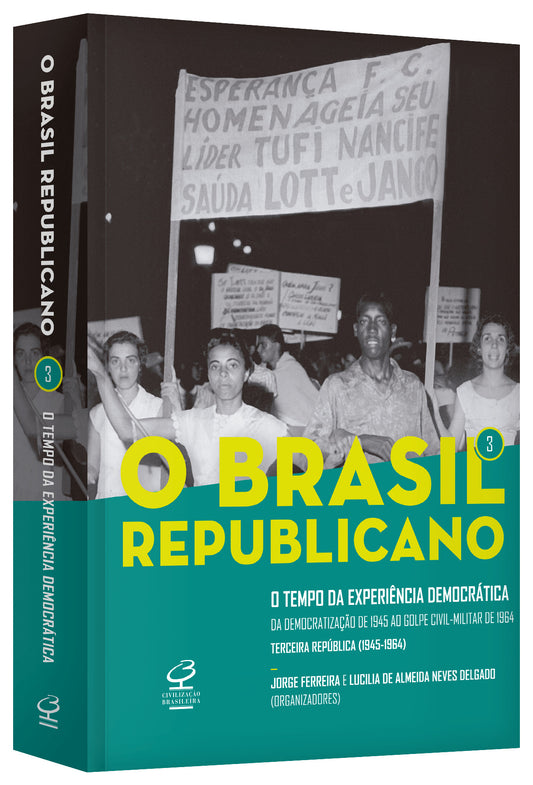
Jorge Ferreira, organizer of the Republican Brazil Collection, revisits the history and importance of Getúlio Vargas's PTB in the construction of modern Brazil in this book The Labor Imaginary.
In "The Labor Imaginary," Jorge Ferreira presents how, between 1945 and 1964, the ideals represented by Getúlio Vargas's PTB (Workers' Party) fueled previously unprecedented popular mobilizations in Brazil. The period, often understood under the umbrella of populism, gains a renewed interpretation here. By moving away from populist characterizations, which contribute to the period's negative reception, the historian highlights laborism as a political project that expressed the aspirations of workers, union members, and broad sectors of the disadvantaged population.
The first major manifestation of this movement occurred with the emergence of the political and social movement known as "queremismo," in support of Vargas's candidacy for president. With his victory in the 1950 elections, Vargas reinforced his image as a social and labor leader. Alongside the president, his Minister of Labor—a young politician named João Goulart—stood out, rebuilding relations between the labor movement and the PTB.
The crisis of August 1954, which followed Vargas's death, elevated the party's ideals to a new level, forming a political alliance that included politicians, workers, intellectuals, trade unionists, and the military. Led by João Goulart, heir to the Vargas legacy, this labor coalition was responsible for the Legality Campaign following the political crisis caused by the resignation of President Jânio Quadros in 1961, and advocated for the implementation of fundamental reforms, a set of popular demands that would serve as the trigger for the 1964 coup d'état.
In "The Labor Imaginary ," Jorge Ferreira revisits key events that marked the democratic period between the Estado Novo and the military dictatorship, focusing on the political participation of the population. We thus understand how Vargas became a reference point for a new political movement of workers identified with his proposals and, most importantly, how these ideas culminated in the abrupt interruption of the Brazilian democratic experience in 1964, with the reactionary triumph that overthrew the João Goulart government.
"This revised and expanded edition examines some paradigmatic moments of this participatory experience, which, on the one hand, involved party and union leaders, and, on the other, the urban population and a good portion of rural workers. Following this trajectory, the author recovers the ideas, beliefs, symbols, slogans, and behaviors consolidated within labor's political culture." – Angela de Castro Gomes